
UDI Labeling for Medical Devices
Is your UDI legible, complete and correct on every product – even at full line speed?
UDI labeling is no longer a future task for medical device manufacturers. The requirement was introduced step by step according to risk class – for many manufacturers it has long been part of daily business. The numbers are assigned, the data is in the system. What matters now is what actually ends up on the label and the packaging at the end of the line.
This is exactly where INTREX comes in. We develop labeling and inspection systems that apply your UDI to the product reliably and verify every code directly in the line. Validatable, audit-ready and fully documented. Custom-engineered instead of off-the-shelf.

Why does the line decide whether you comply with UDI requirements?
Only half the battle.
Most UDI projects are known to start at the desk: selecting an issuing agency, defining the Basic UDI-DI and UDI-DI, maintaining master data, registering products in EUDAMED. These steps are laborious – and yet only half the battle.
The whole truth.
Because the UDI system only works if the code on the physical product is correct. An unreadable Data Matrix code, an incorrectly transferred expiry date or a mixed-up label is enough to break traceability.
In the worst case, this is only noticed by the hospital at goods receipt – or by the authority during an inspection. Then delivery capability, audit readiness and, in the worst case, patient safety are at stake.
The question is therefore not only:
Do we have a UDI?
Do we apply it to the packaging of every single product without errors – and can we prove it?
What does UDI labeling mean for medical devices?
UDI stands for Unique Device Identification. With the Medical Device Regulation (EU) 2017/745 (MDR) and the In Vitro Diagnostic Regulation (EU) 2017/746 (IVDR), the EU introduced a uniform system that allows medical devices to be clearly identified and traced from the manufacturer to the user.
The aim is to implement field safety corrective actions faster, assign incidents cleanly, make counterfeiting more difficult and simplify processes in hospitals and in trade.
What components does a UDI consist of?
Every UDI consists of two parts:
UDI-DI · Device Identifier
Identifies a specific product model and a specific packaging level. Remains the same throughout the product life cycle.
UDI-PI · Production Identifier
Contains, depending on the product, the batch or serial number and the manufacturing and expiry date. Changes from lot to lot or from unit to unit.
In addition, there is the Basic UDI-DI. It does not appear on the label, but links products with the same intended purpose, risk class and essential characteristics in the technical documentation, in certificates and in the EUDAMED database.
Who assigns the UDI?
The UDI cannot simply be made up. Manufacturers obtain it through one of the issuing entities designated by the EU Commission:
Their standards define how the data is structured and in which format it is encoded.
How must the UDI appear on the product?
The UDI carrier must be provided in two forms: machine-readable – as a 1D barcode or 2D code, in practice usually as a GS1 Data Matrix – and additionally as human-readable text for the human eye.
It belongs on the label or the product itself and on every higher packaging level; shipping containers are exempt. Reusable devices that are reprocessed before each use must additionally carry the UDI carrier directly on the product.
The code must remain legible throughout the entire intended use – even after storage, transport and sterilization of the packaging.
Which deadlines apply to UDI labeling?
The UDI labeling requirement was not introduced all at once, but step by step – staggered by the risk class of the product. Separate transitional provisions partly apply to direct marking of reusable devices and to in vitro diagnostic devices.
Which deadline is relevant for your product therefore depends on risk class, product type and the applicable legal framework.
- Medical devices (MDR) Regulation (EU) 2017/745 · Article 123
- In vitro diagnostic devices (IVDR) Regulation (EU) 2017/746 · Article 113
Regardless of the specific deadline, the following applies to manufacturers: The data in EUDAMED and the code on the product must match – at all times and for every unit.
Where do errors occur in UDI labeling in practice?
The UDI-DI is defined once. The UDI-PI, on the other hand, is generated and printed anew for every order, every batch or every unit. It is exactly at this point – the transition from data to print – that typical sources of error arise:
- Poor print quality: smeared, too faint or distorted codes that the scanner at the hospital cannot read.
- Content deviations: The batch or expiry date in the code does not match the human-readable text.
- Mix-ups: Labels from a previous order or a different product variant end up on the wrong packaging.
- Missing or misplaced labels: The label sits crooked, is folded or is missing altogether.
- Difficult surfaces: Curved, transparent or reflective packaging makes reading difficult.
- Incomplete records: The labeling was correct, but cannot be proven in an audit.
Spot checks at the end of the shift reveal such errors too late. By then, scrap has already been produced and downstream process steps have run. UDI labeling only becomes process-reliable when every product is inspected directly in the line.
Where does INTREX come in with UDI labeling – and where not?
We say it openly: INTREX does not assign UDIs, does not maintain master data and does not register products in EUDAMED. These tasks lie with you as the manufacturer, your issuing agency and your enterprise software.
- UDI assignment
- Master data maintenance
- EUDAMED registration
Our focus is the physical, optical level of the line. That is, everything that happens when your UDI data becomes a printed label on a real product: labeling, printing, inspecting, documenting.
- Labeling
- Printing
- Inspecting
- Documenting
Here we bring in our experience from serialization in the pharmaceutical industry – an environment in which the requirements for code quality, validation and documentation have been high for years.
Which services does INTREX offer for UDI labeling?
How does the UDI get onto the label and packaging reliably?
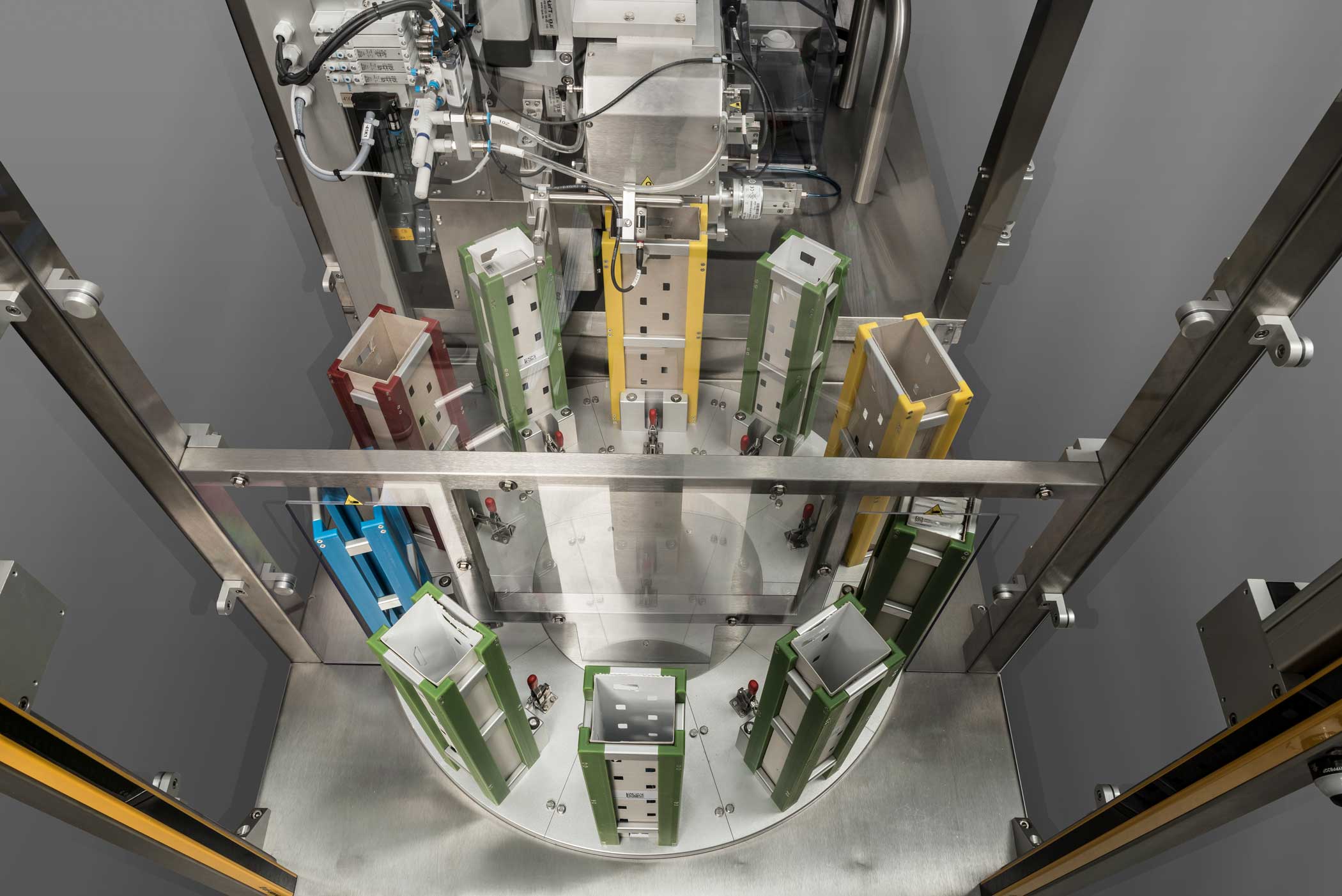
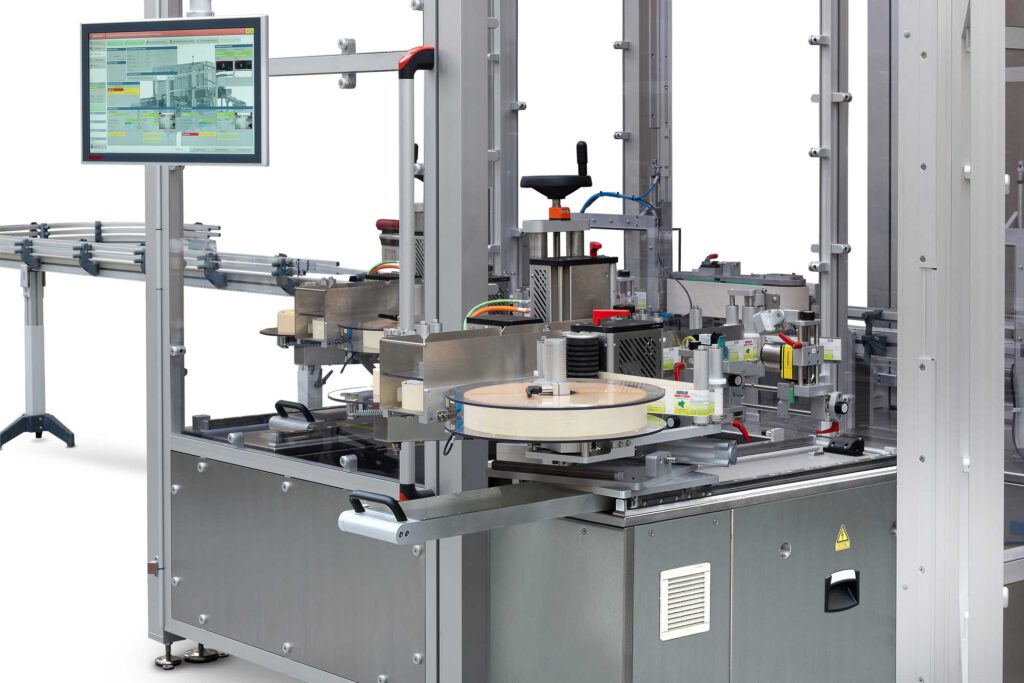
Our labeling systems are engineered for each application – matched to container shape, label position and line speed. Depending on the task, we combine label dispensers, top and bottom labeling, side or wrap-around labeling and multiple labeling. For the variable data of the UDI-PI, labelers can be equipped with integrated digital printing, so that batch, expiry date and code are applied to the label directly in the line.
Where tamper evidence is required, we complement the labeling with seal labels as first-opening protection.
How is every UDI code inspected directly in the line?
Printed is not yet inspected. Our vision systems read 1D and 2D codes inline and compare the content with the target values. Label and print image inspection also checks whether the label is present, complete and correctly positioned and whether the human-readable text matches the code.
On round, curved or reflective surfaces we use 360-degree code reading: Several cameras capture the code redundantly, even if it is damaged or reflective. Defective products are detected before they leave the line.
How is UDI inspection documented without gaps?
With KUPvision you control all inspection stations through one software: central operation, real-time evaluation and gapless logging of every inspection result. This way, in an audit you can not only claim but prove that every unit was labeled correctly.
Can the systems be validated?
Yes. We develop according to the principles of EU GMP and GAMP 5 and supply the qualification documentation for DQ, IQ, OQ and PQ. Software and inspection models are versioned, changes are traceable. This allows our systems to fit into your quality management system – instead of creating new problem areas there.
What if the standard solution does not fit?
Then we build one that does. Unusual containers, tight space conditions or integration into existing systems are solved through our special machine building. Product handling, optics, lighting, camera position, evaluation logic and documentation are designed together with you. Whether, for example, the inspection of directly marked codes can be integrated into your line is clarified on a case-by-case basis.
What does a UDI project with INTREX look like?
Capture requirements
We analyze your product, the packaging levels, your labels and code formats as well as the existing line.
Develop the concept
We design labeling, printing and inspection as one coherent system – including the interface to the data your system delivers.
Design and build
We manufacture the system in our engineering department and prepare the integration.
Integrate and qualify
We commission the system in your line and support the qualification with complete documentation.
Support in operation
Even after start-up we remain your contact – for service, adjustments and extensions over the entire life cycle.
What do you gain from inline inspection of your UDI?
Process reliability
Every product is inspected, not just a sample.
Less scrap and rework
Errors are detected where they occur, before further process steps run.
Audit readiness
Gapless logs prove correct labeling to the notified body and the authority.
Delivery capability
Your customers receive goods whose codes they can scan without problems at goods receipt.
One point of contact
Labeling, printing, inspection and documentation from a single source – without interface problems between several suppliers.
Frequently asked questions about UDI labeling of medical devices
Is UDI labeling mandatory for all medical devices?
In principle, yes. With the exception of custom-made devices and investigational devices, all medical devices under the MDR must carry a UDI carrier. When the obligation applies to a specific product depends on its risk class; the binding transition periods are set by the MDR itself.
What is the difference between UDI-DI and UDI-PI?
The UDI-DI identifies the product model and the packaging level and stays the same. The UDI-PI contains production-related data such as batch, serial number or expiry date and changes continuously.
Which code is used for the UDI?
1D barcodes and 2D codes according to the standard of the respective issuing agency are permitted. In practice, the GS1 Data Matrix has become established because it holds a lot of data in a small area. Human-readable text is always required in addition.
Must the UDI appear on every packaging level?
Yes, on the label or the product and on all higher packaging levels. Shipping containers are exempt.
Does INTREX assign UDI numbers or register products in EUDAMED?
No. Assignment is done through an issuing agency such as GS1, registration by you as the manufacturer. INTREX ensures that your UDI is printed, labeled, inspected inline and documented correctly.
Can INTREX systems be integrated into existing lines?
Yes. Our systems are designed for the respective application and can be integrated into existing systems. What effort is involved is clarified together during requirements capture.
How do you start your UDI project with INTREX?
You have your UDI data under control – and want to be sure that it is also correct on every product?
Then let's talk about your line. Tell us about your product, your packaging and your requirements. We will show you how labeling and code inspection can be implemented reliably and in a validatable way.