Inline Inspection for Critical Production Processes
Inspecting quality while production is running.
Quality inspection at the end of the production process – the risk of “spilled milk”
Scrap has already been produced and downstream process steps have already run. In the worst case, delivery capability, audit readiness or product safety are at stake.
INTREX moves quality control into the running process. Products, codes, features and process data are detected, evaluated and documented where they arise: directly in the line, at real cycle rates and under real production conditions.
The goal is clear: detect defects earlier, make inspection decisions reliable and reduce production risks. Allow no spilled milk.
Inspection architecture instead of buying a camera.
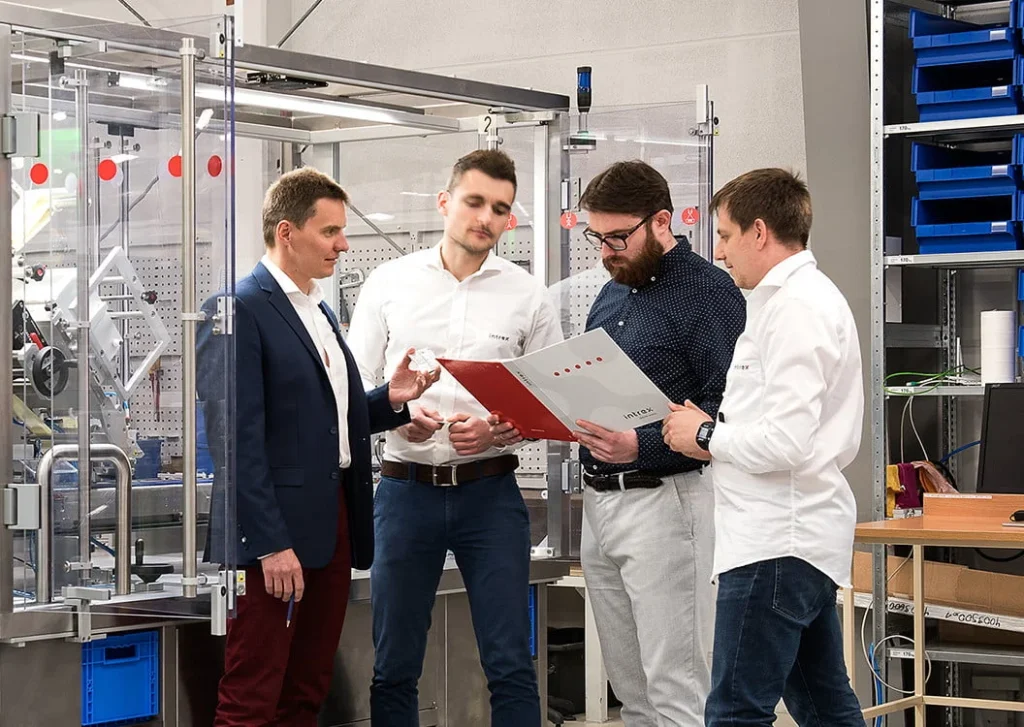
A camera produces an image or image sequences. A reliable inspection process only emerges from the interplay of all relevant factors: product handling, optics, lighting, inspection position, speed, software, data logic and documentation.
INTREX develops this architecture starting from the specific production task. Product, feature, surface, line, cycle time and documentation requirements determine the solution. The result is systems that work in day-to-day operation and not only under ideal test conditions.
Typical inspection tasks
INTREX detects and verifies codes and plain text, inspects even the smallest features on round, curved or reflective surfaces, and checks labels, print images, positions and completeness.
360-degree capture in the running production process, changing product variants, tight tolerances and different inspection parameters also become manageable within one continuous inspection architecture. Results, events and process data can be documented in a traceable way.
Code recognition and 360-degree inspection
With small codes, curved surfaces and changing product orientations, simple camera logic quickly reaches its limits. A single frontal view is then not enough.
INTREX combines product handling, camera positions, lighting and proprietary evaluation logic into a reliable inspection architecture. Several perspectives can be merged in software, codes can be captured reliably and results can be documented.
This makes even demanding tasks manageable: for example the smallest codings on round pharmaceutical vials, high cycle rates and 360-degree capture in the running process.
In-house software as the backbone of the inspection process
Standard software covers standard cases. Critical inspection tasks often require logic that fits the reality of production exactly.
INTREX develops customer-specific inspection, evaluation and control software. Inspection parameters, tolerances, product variants, user guidance, interfaces, data transfer and documentation are built for the specific application.
This gives you control over the entire inspection process. No black box. No rigid platform logic. The software follows the task, the line and the required evidence.
AI-based pattern recognition: a tool with a clear task
AI becomes relevant where rule-based image processing reaches its limits: with varying surfaces, complex patterns, deviations that are hard to describe, or features with high variance.
Industrial benefit decides whether it is used. The analysis must work reproducibly and be embedded in software logic, inspection decision, documentation and line process. This turns AI from a demo effect into usable inspection intelligence in the running process.
Integration into existing production lines
The line sets the rules: cycle time, installation space, product handling, interfaces, operation, maintenance and data structure.
INTREX considers mechanics, electrical engineering, image processing and software together. The solution is designed so that it can be integrated into existing machine and process structures and supports running operation reliably. The inspection process becomes part of production. That is exactly where it takes effect.
Documentation, validation and audit readiness
In regulated production environments, more than a technical pass/fail decision counts. Inspection parameters, results, events and system states must be documented in a traceable way.
INTREX combines inline inspection with the required data and evidence logic. For pharmaceutical and life science applications, depending on the project, this also includes qualification, IQ/OQ, GAMP 5-compliant software logic and audit-ready documentation. This turns technical detection into a reliable inspection process.
What INTREX achieves in the production process.
Defects are detected earlier, before further scrap is produced. Line processes gain stability and transparency, and inspection decisions become reproducible and documentable. Downtime, recall and audit risks decrease. Quality control becomes an integrated safety factor of production.
Optical quality control: inspect instead of assume.
Defects that only become apparent at the end of the line have already happened. Optical quality control moves the decision to where it has an effect: into the running process.
INTREX inspects codes, plain text, labels and surface features camera-based and in real time – even on curved, reflective surfaces, such as the smallest codings on round pharmaceutical vials, ampoules and prefilled syringes. Several camera perspectives are merged in software into a complete image (360° capture) and evaluated with the proprietary software KUPvision, which centrally controls multiple cameras and readers, evaluates image data in real time and logs inspection results. In addition, the Glasbruchkontrolle GBD 650 uses AI to detect microscopic cracks and surface defects on glass containers.
In regulated environments, optical quality control is more than a pass/fail decision. INTREX inspection systems are developed according to EU GMP, GAMP 5 and in line with the Annex 22 draft on artificial intelligence: statically versioned models, separate training and test data, complete DQ/IQ/OQ/PQ documentation based on the user requirements (URS).
How does optical quality control differ from a camera at the end of the line?
Optical quality control at INTREX takes place inline – codes, labels and surfaces are inspected while the line is running, not downstream. This reduces scrap and makes inspection decisions reproducible and documentable.
Which industries is the solution suitable for?
INTREX uses optical inspection systems primarily in the pharmaceutical and life science industries as well as in food production – for example for glass containers, labels and code markings.